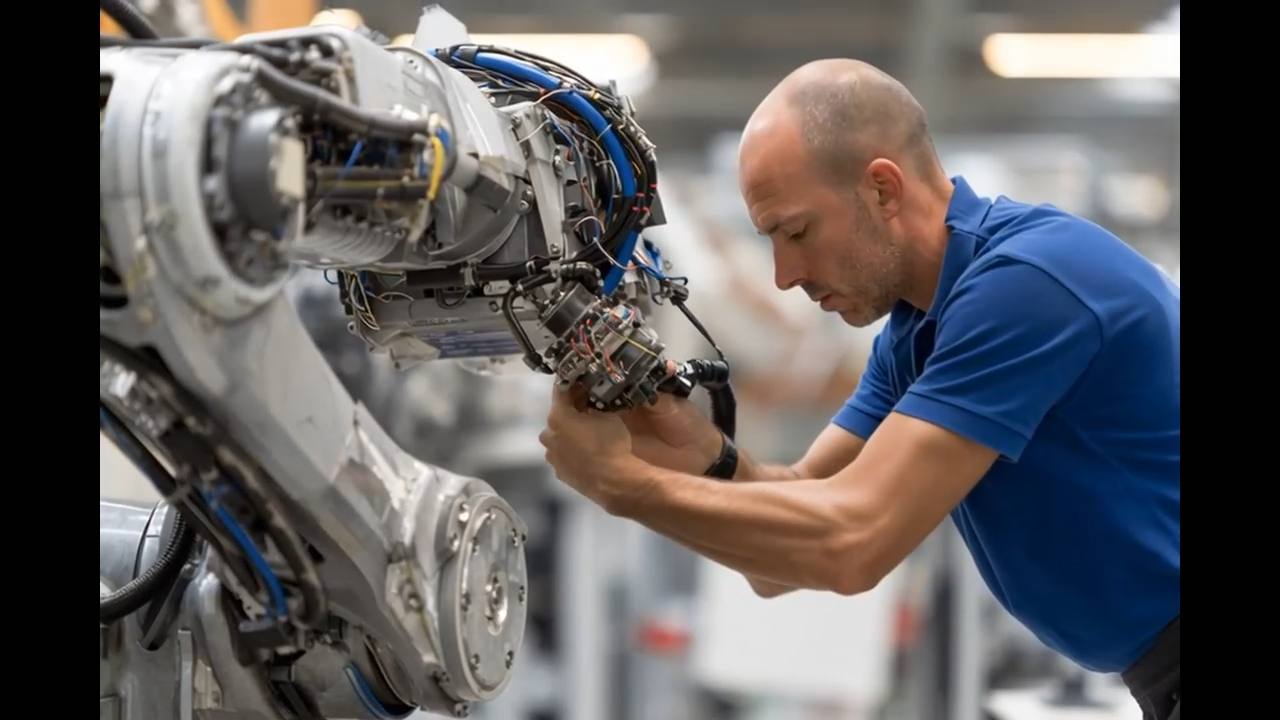
Whether a mould or fixture is correctly seated depends on forces, stresses and contact conditions that are expensive and intrusive to measure directly. Instrumented fixtures with load cells or strain gauges work, but they cost thousands per machine and usually need the equipment manufacturer’s involvement. Without them, set-up quality rests on operator experience, and errors surface only when material has already been wasted.
The physics problem
A perfectly static preload emits no signal, so a passive sensor cannot simply listen for it. The information lives elsewhere: in the vibro-acoustic transients of the set-up itself as parts clamp, latch and settle, and in the way a structure’s modal response shifts as contact stiffness and preload change. Probing the assembly after clamping, with a light standardised excitation or the machine’s own motion transients, makes that information observable.
A virtual sensor, not a black box
A virtual sensor estimates a quantity that is not measured directly from others that are. The approach that suits this problem combines a reduced-order physical model of the fixture with learning where the physics is incomplete.
- States are the modal coordinates of the fixture model plus slowly varying contact parameters such as stiffness and preload.
- Unknown set-up forces are treated as additional inputs to be estimated jointly with the states, in the tradition of Kalman-filter joint input–state estimation.
- Observations are features extracted from multiple vibration and acoustic channels.
- A learned residual corrects systematic model mismatch, which is where machine learning adds most value.
Grounding the estimator in physics makes it more transferable between tools, easier to trust and easier to set defensible tolerance limits for than a purely data-driven model.
Uncertainty you can act on
A verdict such as “seated within tolerance” or “re-adjust” is only useful if its reliability is known. Conformal prediction wraps the estimator’s output in prediction sets with a guaranteed coverage level, calibrated per tool. The operator gets an answer with a stated error bound rather than an unexplained score.
Running on the edge
Modern microcontrollers with DSP extensions can run quantised INT8 models in tens of milliseconds. Keeping the entire pipeline on-device, from feature extraction to verdict, removes any cloud dependency, keeps production data on the machine and brings hardware costs down to a level that smaller suppliers can afford. Calibration for a new tool should take hours, not weeks; that is often the difference between a demonstrator and a product.