
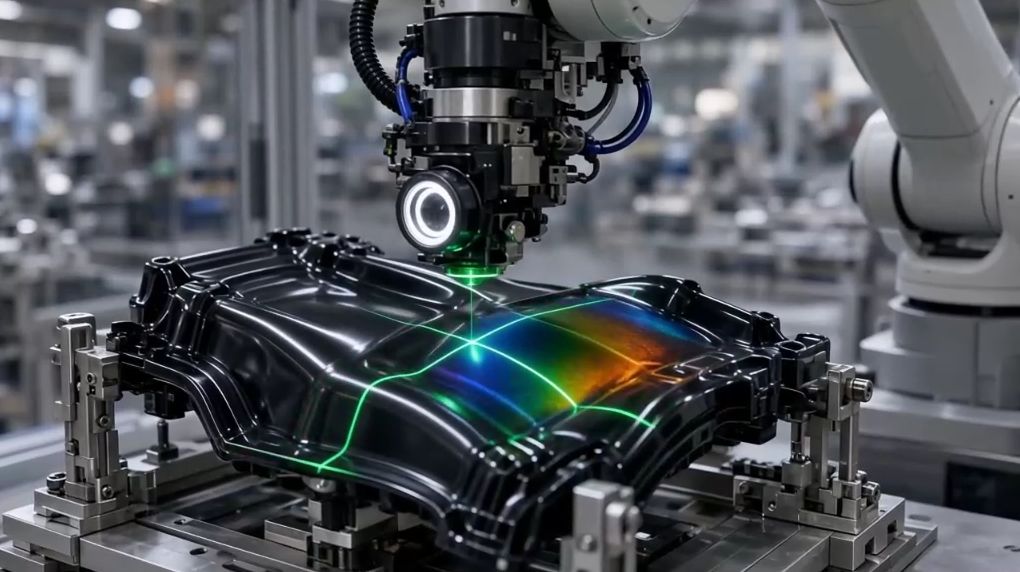
Plastic intermediate components, whether moulded, extruded or thermoformed, carry a family of defects that are easy to describe and hard to see: sink marks, warpage, flash, surface cracks, colour variation and contamination. Inspection is still often manual or semi-automated and usually happens at the end of the line, where a missed defect has already consumed material, machine time and energy.
Why 2D vision is not enough
Conventional machine vision relies on contrast in a 2D image. Plastics work against it. Glossy surfaces produce specular highlights that move with the viewing angle. Translucent and lightly pigmented materials scatter light below the surface. Many of the defects that matter most are geometric rather than visual: a shallow sink mark or a slight warp can be almost invisible in a photograph and obvious to a profilometer.
Three complementary modalities
- High-resolution 2D imaging remains the best tool for colour inconsistency, contamination and surface marks.
- 3D laser triangulation measures surface geometry directly, which is what sink marks, warpage and flash really are.
- Infrared thermal sensing can reveal near-surface anomalies such as voids and delamination that neither of the others can see.
Each modality is strong where the others are weak. The engineering problem is making them work together.
Fusion on a moving robot
Mounting sensors on a six-axis industrial robot allows complex parts to be scanned from the right angles, but it adds constraints. The robot must hold a constant standoff distance and correct its path adaptively so that measurements stay comparable across the part. All modalities need to be registered to the same coordinate frame and time base.
Fusion can happen early, on raw data, or late, on per-modality predictions. In practice, intermediate fusion of learned features from each channel, using convolutional and Transformer-based models, offers a good balance between accuracy and robustness when one channel is noisy. The latency budget is strict: inference has to keep pace with the line, which pushes model design towards compact architectures and careful optimisation.
From detection to correction
A defect map is only useful if something acts on it. When defect locations and severities are expressed in the robot’s coordinate frame, they can be converted directly into path-planning targets for a second robot that polishes or deburrs the part before it moves on. Inspection stops being a gate and becomes the first half of a repair loop.
Keeping people in charge
Operators need to trust what the system reports. 2D and 3D heatmaps that show where a defect is and how severe it is, confidence scores on every classification, and a simple way for an operator to confirm or override a verdict make the system explainable and let it learn from the people who know the parts best.