The problem worth solving
Proposing crystals was never the hard part
Generative AI can now propose thousands of plausible crystals in an afternoon. Proposing them was never the hard part. The hard part is knowing which ones deserve a week of DFT or a month in the lab.
Most tools answer that question with a single model’s opinion, delivered without error bars. Our own audit showed what that costs. The open reference data that most stability scores rest on held 49 wrong entries. Each one could make a good crystal look unstable, or a poor one look stable. One of them alone made every cobalt oxide in the database look grossly unstable.
Assayer is built on a simple principle. A candidate is only as good as the evidence behind it.
How it works
From brief to shortlist in three steps
Generation
Two engines, and the right one for the job
Open-ended searches and property targets go to a diffusion model. When the crystal symmetry matters, a symmetry-native transformer does the work. And when you already know where the answers are likely to be, the diffusion model can learn it from your own labelled structures.
A diffusion model (MatterGen)
For open-ended searches and property targets.
A symmetry-native transformer
The Wyckoff Transformer, for when the crystal symmetry matters. Asked for the orthorhombic Pnma structure, it put 41 of 64 crystals on target. A diffusion model fine-tuned for that symmetry managed 2 of 64.
Trained on your structures
In our tests, a three-hour fine-tune on 5,000 structures taught the diffusion model a target symmetry it had never been steered towards before: 28 of 64 crystals on target, against 0 of 64 without it.
What we check, and how far to trust it
Every verdict comes with its accuracy
Most platforms tell you what a model predicted. We also tell you how often that kind of prediction is right.
| Check | How it is measured | Accuracy, measured against DFT |
|---|---|---|
| Thermodynamic stability | Energy above the convex hull of 845,997 audited reference materials; a second, independent potential gives its own verdict | Typical error 0.015 eV/atom on known stable crystals; 119 of 119 correctly called stable |
| Novelty and uniqueness | Structure matching against the same reference set and within your results | Deterministic |
| Crystal symmetry | Space group of the relaxed structure, not the raw output | Deterministic |
| Stiffness (bulk modulus) | Equation-of-state fit with the atoms relaxed at every volume; a separate model for magnetic crystals | Typical error 6 GPa (non-magnetic) and 10 GPa (magnetic) |
| Metal or non-metal | Graph neural network, made independent of how the unit cell is written | 98% correct on recently computed crystals; 92% on the standard MP-20 benchmark |
| Band gap | Same model, calibrated on training data only | Typical error 0.3 to 0.4 eV for semiconductors and insulators |
| Magnetisation | Universal potential with magnetic moments | Magnetic yes/no right on 16 of 16 decided calls in our DFT spot-check of generated crystals |
The accuracy thresholds were fixed before each model was measured. Five candidate methods failed their threshold, and we did not ship them.
We tell you when not to trust us
Caveats on the result itself
Every model has chemistry it handles badly. Ours do too. The difference is that Assayer says so, on the result itself.
Checked against quantum mechanics
Not just against other models
Machine-learning potentials are fast because they approximate. So we check the approximation. A sample of each campaign’s candidates can be recalculated with density functional theory (Quantum ESPRESSO, with settings modelled on the Materials Project’s).
That shows how the models perform on your chemistry, not just on textbook crystals. The check has already earned its place, on the stiffness of the iron–rhodium alloy FeRh.
First reading
Our first DFT check of generated crystals found that one model read magnetic iron alloys at half their true stiffness.
94GPa
Density functional theory
Recalculated from first principles, FeRh came out at roughly twice that figure.
204GPa
Within a day
Magnetic crystals were routed to a model that gets them right. FeRh now reads within 10 GPa of DFT.
195GPa
Self-driving laboratories
From shortlist to the lab, and back
Assayer has an interface for self-driving laboratories. Shortlisted candidates pass to automated synthesis and characterisation, and the measurements flow back into the next campaign.
The loop between prediction and experiment closes, and every measurement is kept beside the prediction it tested.
Lab-ready shortlists
Candidates, structure files and target properties in machine-readable form, ready for a robotic platform’s queue.
Measurements flow back
Measured results fine-tune the generator, so each campaign starts where the last one’s experiments left off.
Predictions held to account
Every measured result is recorded against its prediction, so you see how the models perform on your chemistry, run after run.
Who it is for
Built for industrial R&D and for research groups
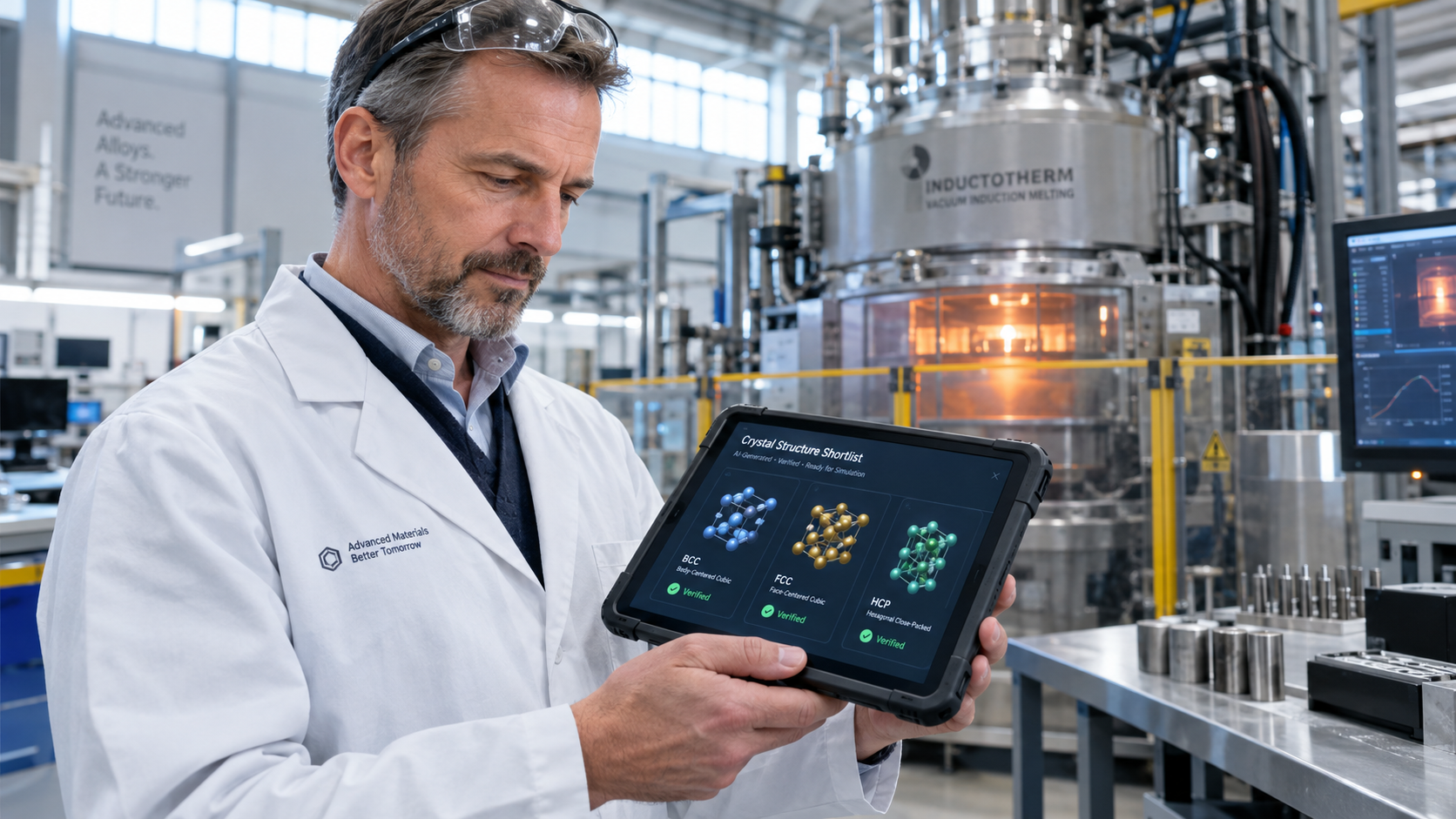
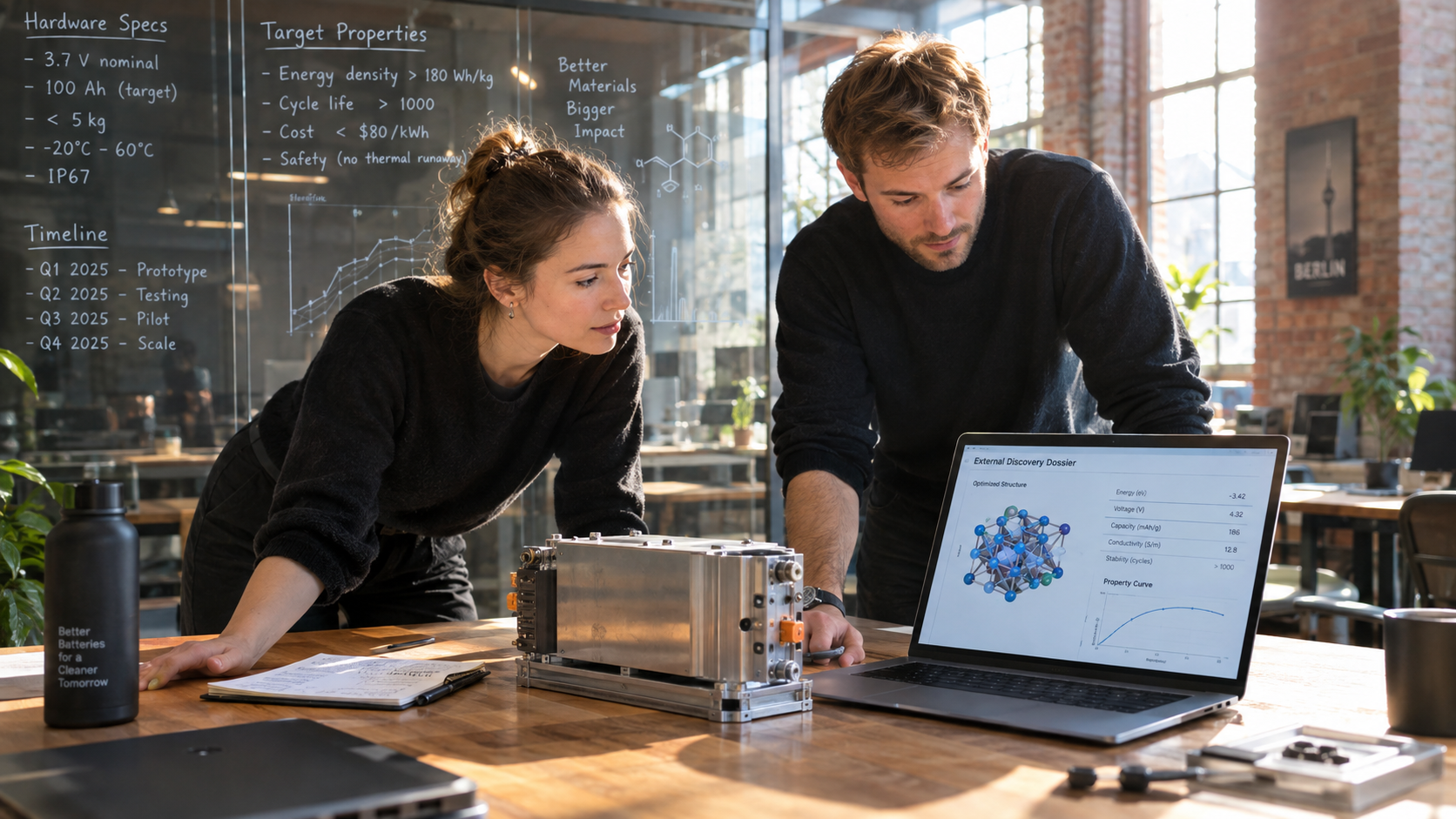
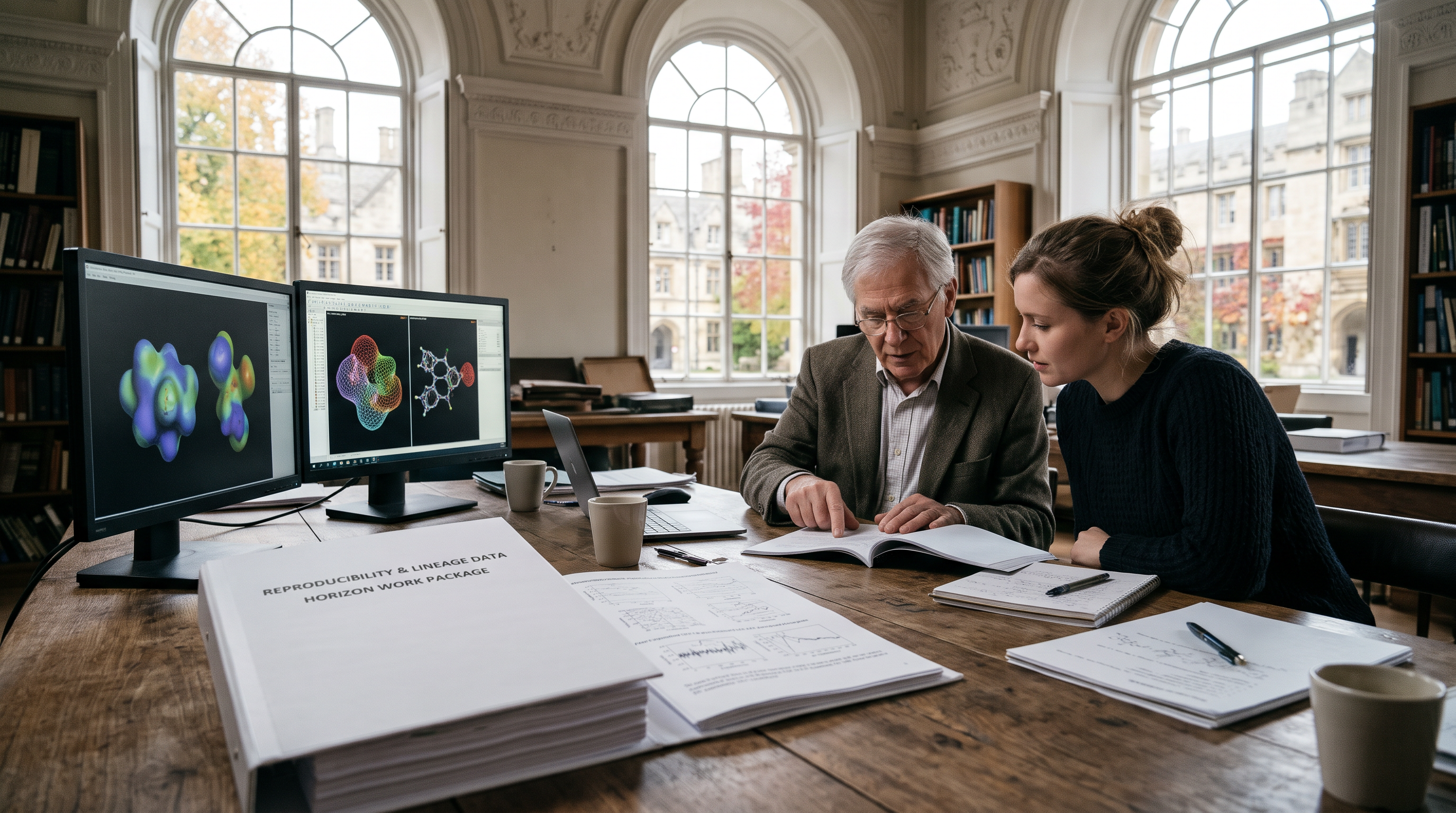
For industrial R&D
- Your brief stays yoursTargets, training data and results belong to you. Campaigns run on our own GPU hardware, only the team on your campaign can see your data, and nothing is sent to a third-party AI service or used to train models for anyone else. Everything is deleted on request. Data is processed under the GDPR, and contracts are governed by Maltese law.
- Train on what you knowFine-tune the generator on your own measured or computed properties, so it searches where your experience says the answers are.
- From brief to shortlistA pilot ends with ranked candidates, each with its evidence, structure files and a written assessment, ready for your simulation or synthesis team.
For research groups
- Reproducible by constructionOn the same hardware, the same request with the same seed generates byte-identical crystals. Every result records the models, versions, numerical precision and settings that produced it.
- Methods you can citeAcceptance thresholds are fixed before measurement, calibration sets are published, and negative results are reported.
- Built on open scienceAlongside our own internal models, the models and data underneath are open-source and openly licensed (credits below).
How a pilot works
From scoping call to report in four steps
Length, price and scope are fixed at the scoping call, before any work starts.
Questions
Asked and answered
- Does Assayer replace DFT?
- No. It decides which candidates deserve DFT, and it uses DFT to keep itself honest. A typical campaign screens thousands of candidates with machine-learning potentials. Only a short list goes on to first-principles calculation, and then to your lab.
- What does “novel” mean here?
- That no structurally matching crystal exists among the 845,997 reference materials, which combine the Materials Project and Alexandria databases. Novel is not the same as synthesisable. We say which candidates are stable and how confident we are, and leave the synthesis judgement to your chemists, with the evidence to make it.
- Which chemistries are hardest?
- The lanthanides, especially gadolinium and europium, and magnetic transition-metal oxides. There both the reference data and the models are least reliable. Assayer flags these on every affected result, and has corrected the reference entries it could confirm independently.
- Can it design alloys?
- It already tells metals from non-metals, and measures stiffness and magnetism. Alloy-specific checks are in development: full elastic constants, hardness and ductility, lattice-dynamical stability, order versus disorder, and the cost and supply risk of the elements.
- Is this Microsoft’s MatterGen?
- Assayer is an independent service. It uses MatterGen, Microsoft’s open-source generative model, as one of its engines, alongside other open models and our own internal ones. It is not affiliated with or endorsed by Microsoft, or by any of the projects credited below.
- Who owns what Assayer finds?
- You do. Candidates, structure files and reports generated for your campaign are yours. We do not reuse your brief, data or results for anyone else.
Credits and notices
Built on open science
Assayer is an independent service of Algorithmic BrAIn and is not affiliated with or endorsed by Microsoft or by the authors of these projects. Accuracy figures are measured on the benchmark sets described in our methods notes; performance on new chemistry may differ, which is why every result carries its confidence tier.
- GenerationMatterGen (Microsoft Research, MIT licence), the Wyckoff Transformer (Apache 2.0), and our own internal generative models, not publicly released
- VerificationMatterSim (MIT), MACE-MPA-0 (MIT), CHGNet (BSD), PET-MAD (BSD-3) and ALIGNN (weights CC BY 4.0)
- Simulationtorch-sim (MIT) and Quantum ESPRESSO (GPL)
- Reference dataThe Materials Project and Alexandria (CC BY 4.0)